When Is Upgrading Commercial Heating Better Than Reactive Repairs?
By RJP Group
Upgrading commercial heating is usually more suitable than continuing with reactive repairs when faults keep returning, the building is not being heated reliably, or the cost and disruption of keeping the existing arrangement running are becoming difficult to justify.
That does not mean every breakdown calls for replacement. A relatively modern system with a clear, isolated fault may be better repaired. The decision should consider the condition of the equipment, the pattern of failures, the effect on building users and the likely cost and risk of keeping the current arrangement operational.
In short: repair an isolated fault when the wider heating arrangement remains dependable. Start comparing an upgrade when failures repeat, performance is poor, support is uncertain or another breakdown could seriously disrupt the building.
When do repeated repairs suggest that an upgrade is needed?
The strongest warning sign is not one expensive invoice but a pattern of recurring faults. If the same equipment or connected part repeatedly fails, replacing that individual item may not deal with the underlying condition of the installation.
Repeated problems can be associated with age, wear, compatibility issues, control problems or wider plant-room limitations. Ask for a record of what has failed, what was repaired and whether the latest issue is connected to earlier work.
Consider an upgrade when reliability is becoming unpredictable
Reactive repairs may no longer be the sensible default if the heating becomes unavailable regularly, needs temporary workarounds or is difficult to support with suitable parts and technical information.
The important question is not only whether a replacement part can be found today. It is whether the existing equipment can be supported reliably for the period your organisation expects to use the building.
Consider an upgrade when the building is not heating consistently
Slow warm-up, cold areas, rooms that overheat or an inability to maintain suitable temperatures can indicate a problem beyond one failed component. The cause could relate to heat generation, controls, circulation, distribution or a change in the building's requirements.
Before approving an upgrade, establish which part of the arrangement is causing the performance issue. Replacing the main heat source alone may not resolve poor controls or uneven distribution.
When is repairing commercial heating still the better choice?
Repair is often more appropriate when the fault is understood, isolated and unlikely to indicate wider deterioration. It may also be reasonable when the equipment remains well supported and the system still provides suitable heat across the building.
A targeted repair is easier to justify when:
the fault is not recurring;
the main equipment remains in sound condition;
the building is being heated consistently;
the controls and distribution are performing as required;
the proposed work is more than a temporary workaround; and
there is no known change in building use or heating demand.
Even then, ask what caused the failure and whether related components should be checked. Restoring operation does not, by itself, show that the system is suitable for the longer term.
How should you compare repair costs with an upgrade?
The useful comparison is not simply the next repair bill against the purchase price of new equipment. It is the cost and risk of keeping the current system operational compared with the capital cost, disruption and expected performance of an appropriately scoped upgrade.
Include the wider cost of reactive repairs
Review more than labour and parts. Repeated faults can also involve diagnostic work, access arrangements, restricted use of rooms, tenant or staff complaints and operational disruption when heating is unavailable or unreliable.
Questions worth reviewing with the maintenance records include:
Which components have failed more than once?
Are repairs becoming more complex or difficult to arrange?
How often has heating been unavailable or below the expected standard?
Are temporary fixes being used because a complete repair is difficult?
Could another failure occur at a particularly disruptive point in the building's operation?
Understand what an upgrade would actually involve
An upgrade may involve more than replacing the main heat-generating equipment. Depending on the existing installation, it could require changes to controls, pumps, pipework, flues, electrical supplies, water connections or other plant-room elements.
Ask for the proposed scope to separate essential work from optional improvements. It should also explain any design, access, compliance, commissioning and building-use considerations that affect the overall decision.
Does better efficiency justify upgrading commercial heating?
Potential energy savings can support an upgrade decision, but they should not be assumed from the age of the equipment alone. Poor settings, ineffective controls, heat losses or distribution problems can reduce performance even when the main heat source is not especially old.
Replacing one item without addressing those issues may leave the building with similar comfort or operating problems. Assess the heating arrangement as a system, including:
whether output matches the building's current use;
whether occupied and unoccupied periods are controlled appropriately;
whether different areas have different operating requirements;
whether pumps, valves or controls are affecting performance;
whether pipework condition or insulation is contributing to heat loss; and
what operating information will be available after the work.
The practical result for the building matters more than one efficiency figure in an equipment specification.
What plant-room factors affect the upgrade decision?
A commercial plant room needs to be considered as a working system rather than a collection of separate appliances. Space, access, connected services, controls and future maintenance can all affect whether an upgrade is suitable and how disruptive it may be.
Before agreeing a proposal, ask whether the existing plant room has:
adequate space and access for the proposed equipment;
connections and pipework suitable for the new arrangement;
controls that reflect the building's operating requirements;
reasonable access for future inspection and maintenance;
capacity for known changes in use or occupancy; and
a practical way to keep the building operational while work takes place.
A larger system is not automatically better. Capacity and configuration should be explained in relation to the building's actual demand, rather than selected simply because more output appears safer.
How does building use change the repair-or-upgrade decision?
The same heating fault can have very different consequences in different premises. Loss of heating in a lightly used area may be manageable, while disruption in an occupied commercial building can affect staff, visitors, tenants or business-critical activity.
Consider:
how many people rely on the heating;
whether different areas operate at different times;
whether any rooms have particular temperature requirements;
how the organisation would operate if heating were unavailable; and
whether access for installation work is restricted by occupancy, security or the layout of the building.
Where work is being considered in an occupied building, access, sequencing, temporary arrangements and communication should be discussed before the scope is agreed. For a related planning reference, see How to Prepare for Commercial Heating Maintenance in an Occupied Building.
What should you ask before approving an upgrade?
A useful proposal should explain the problem the upgrade is intended to solve. It should not rely on age alone or present replacement as the only response to a breakdown.
What is failing? Ask whether the problem is confined to one component or indicates wider deterioration.
What are the realistic repair options? Confirm whether a repair is expected to be durable or only an interim measure.
What will need to change? Check whether the scope includes controls, pumps, pipework, flues, electrical work or other connected plant-room requirements.
How will the proposal suit the building? The answer should relate to occupancy, operating hours and heating demand.
What disruption should be planned for? Ask about access, work areas, equipment isolation and the effect on occupied spaces.
What ongoing maintenance will be required? Installation is not the end of the decision; the future upkeep should be understood.
What information will be provided afterwards? Clarify what operating instructions, records or system details will be available to the building team.
RJP Group lists commercial heating, plant room installation, and plant room servicing and maintenance among its services in London, Essex and Hertfordshire. If you are comparing another repair with a wider change to the heating arrangement, review the published commercial heating service information and ask whether the listed service suits the requirements of your building.
How should you allow for timing and installation constraints?
Upgrade work can be more involved where the plant room is compact, access is restricted, services need to remain operational or the work must be coordinated around occupied areas.
The sequence may depend on design decisions, equipment availability, approvals, access and the condition of connected services. These factors should be confirmed for the specific building rather than treated as a standard timetable.
For a related planning reference, see What Affects the Timeline for Commercial Heating Installation in an Occupied Building?.
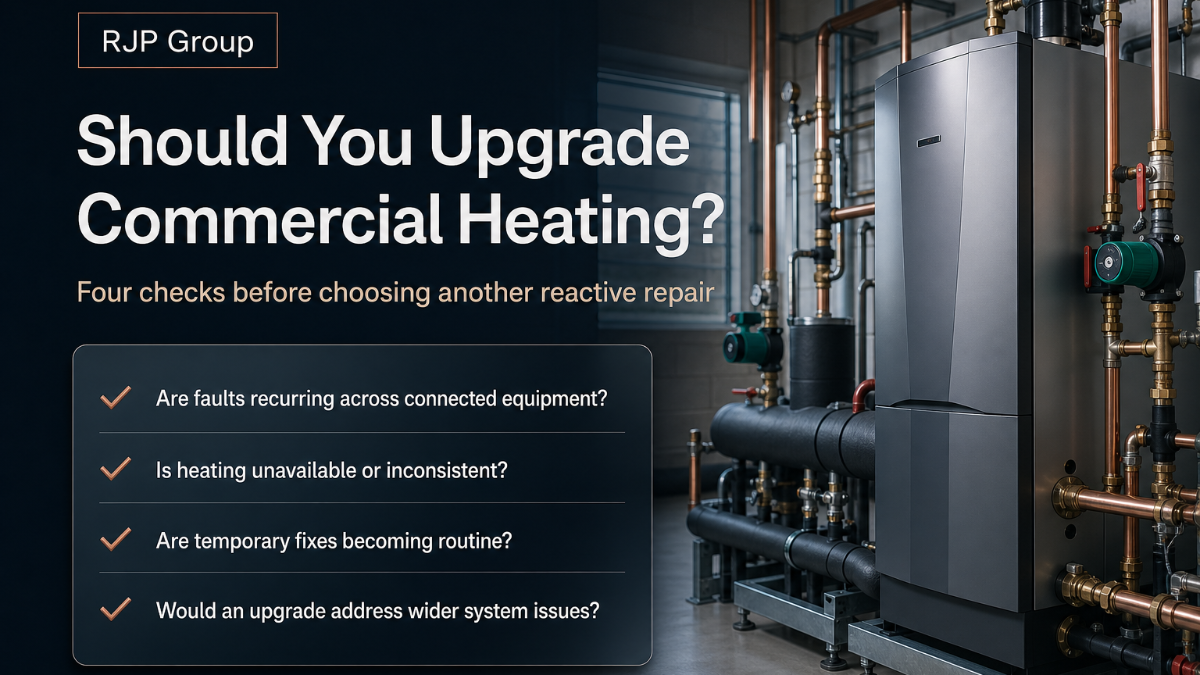
What is the practical repair-or-upgrade test?
Review the decision under four headings:
Reliability: Is the system failing repeatedly or becoming harder to support?
Performance: Does it heat the building consistently and respond to actual operating requirements?
Cost and risk: Are reactive repairs creating increasing direct costs or disruption?
Suitability: Can the current arrangement meet the building's present and reasonably foreseeable needs?
If the answers are favourable, a targeted repair may remain sensible. If several are negative, compare a properly scoped upgrade with the cost and operational risk of continuing reactively.
Ready to review the heating arrangement? If repeated faults or unreliable performance are making repairs harder to justify, contact RJP Group about its commercial heating service.


Talk to us about your project
Tell us about the building, the scope and your programme.
- Call us+44 77717 45294
- Email usinfo@rjpgroup-uk.com
- Service areaLondon, Essex, Hertfordshire
Request a call back
We reply to every enquiry. For anything urgent, please call +44 77717 45294.